

A Guide to Service Quality Programs
A Service Strategies research guide to selecting a quality program that strengthens technology service delivery, customer loyalty, and continuous improvement.
By Greg Coleman
By Greg Coleman
This Service Strategies research guide examines how technology service organizations can select a quality program that supports stronger service delivery, customer loyalty, profitability, and continuous improvement.
Quality programs vary widely. Some offer an improvement methodology, some provide a library of best practices, and others include formal assessments or certification. The guide evaluates seven established approaches and explains how organizations can choose the right fit for their goals.
Why Adopt a Service Quality Program?
A quality program can give service leaders a structured way to improve operations. The right choice depends on the organization’s immediate challenges and longer-term ambitions.
- Create a roadmap for world-class service: Use a clear framework and service standards to guide continuous improvement.
- Address specific business issues: Focus improvement efforts on concerns such as customer satisfaction, process discipline, or service consistency.
- Validate current practices: Confirm the strength of existing operations and uncover additional improvement opportunities through an independent assessment or certification.
- Drive consistency at scale: Establish common practices across geographies, business units, product lines, and customer channels.
- Create a competitive differentiator: Demonstrate a verifiable commitment to service quality for customers and prospects.
Quality improvement is not a one-time initiative. It requires a sustained commitment from leadership and frontline teams alike.
What to Look for When Selecting a Program
The guide recommends evaluating each option against the organization’s needs, goals, and operating environment. Important questions include:
- What is the program’s track record, and who developed its criteria?
- Which organizations participate, and does their profile resemble your own?
- How often are the standards or practices updated to reflect evolving technology and customer expectations?
- Does the program define specific business practices and measurable success criteria, or only broad process areas?
- What are the full costs, including membership, materials, consulting, assessments, certification audits, and staff training?
A suitable program should build on existing processes, provide a clear focus on measurable results, and offer a practical roadmap for continuous improvement.
The Benefits of a Service Quality Program
When a service organization fully commits to quality improvement, it can realize meaningful operational and customer outcomes:
- Higher customer satisfaction and loyalty through better service delivery, clearer expectations, and faster issue response and resolution.
- Improved service consistency through common practices, tools, metrics, strategy, and training across the organization.
- Greater efficiency and productivity by strengthening service processes, staff capabilities, and serviceability practices.
- A culture of continuous improvement that encourages employees to identify and resolve quality issues rather than accept the status quo.
- Best-practice benchmarking to reveal gaps between current performance and leading service organizations.
- Competitive advantage when certification or an externally validated standard can demonstrate the organization’s service-quality commitment.
Seven Quality Approaches Reviewed
The research guide compares seven programs that can contribute to an organization’s quality-improvement efforts:
- Six Sigma: A data-driven improvement methodology that can be applied to service operations. It focuses on measuring and reducing defects, but does not prescribe which service areas to improve or offer organizational certification.
- ITIL: A best-practice framework for IT service management. It provides guidance for managing the service lifecycle, particularly for internal IT operations, but does not itself provide organizational certification.
- CMMI-SVC: A process-improvement model for establishing, managing, and delivering services. It provides formal maturity assessments, rather than organizational certification, and applies broadly across service environments.
- ISO 9001:2008: A general quality-management standard emphasizing process documentation, control, and continual improvement. Independent bodies can conduct certification audits, though its guidance is not technology-service specific.
- ISO/IEC 20000: A service-management standard focused on IT organizations. It can provide a certification path for organizations applying ITIL principles, but is geared toward IT service management rather than customer-facing technology support.
- TSIA / J.D. Power Certified Technology Service and Support (CTSS): A technology-service certification approach that combines operational review with customer satisfaction benchmarking.
- Service Capability & Performance (SCP) Standards: A service and support-specific framework covering eService, support, field service, and professional services, with best-practice guidance, benchmarking, audit-based certification, and annual recertification.
Comparing the Programs
The comparative matrix below highlights important distinctions between the seven approaches, including process control, improvement methods, measurement criteria, best-practice guidance, organizational certification, validation, and cost structure.
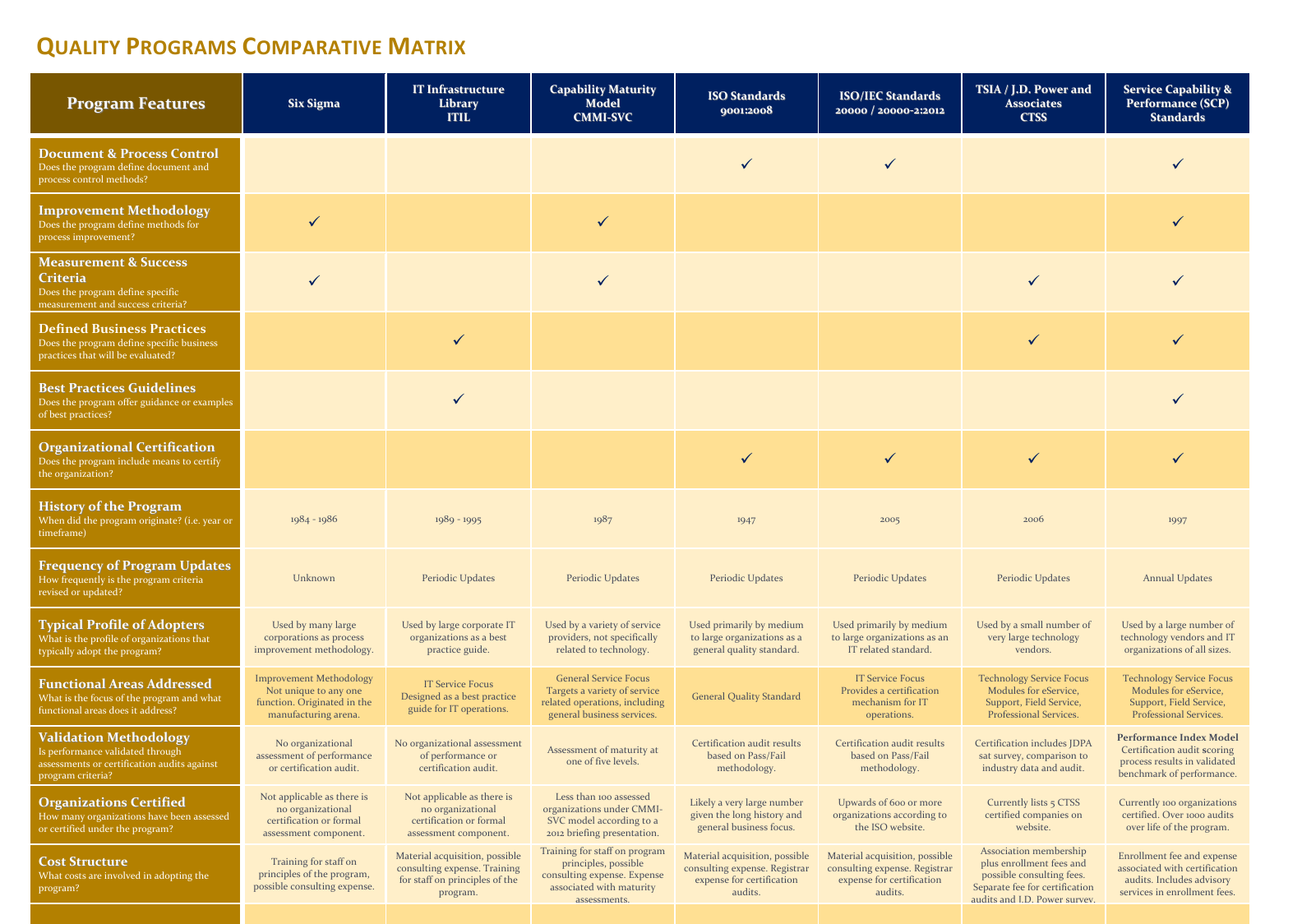
Quality Programs Comparative Matrix
No single program is universally right for every organization. Some companies can benefit from combining an improvement methodology with a standards-based program, because the approaches are not necessarily mutually exclusive.
A Practical Decision Framework
Technology service organizations should begin by defining what they need to improve and how they want to measure success. A program designed specifically for service and support will generally provide more direct guidance for customer-facing service operations than a general quality or IT-management framework.
The guide concludes that organizations should prioritize the program that aligns best with their goals, provides credible and current guidance, and can support ongoing improvement. Quality programs can help service leaders turn a commitment to excellence into more consistent operations, stronger customer relationships, and a durable competitive advantage.

Ready to Transform Your Service Organization?
Let's discuss how our consulting and training services can help you achieve service excellence.